
Turin surprises anyone who decides to explore it with curious eyes. Beyond the classic landmarks such as the Mole Antonelliana (which is already quite a peculiar building, even for its history…) and the Egyptian Museum, the city holds a wealth of curiosities, unusual details and little-known stories. Here is a small guide to the most curious and unusual things to see in Turin: an itinerary through bizarre architectures, urban legends, lucky charms and masterpieces of urban creativity. From the eccentric Palazzo with the Piercing to the sinuous Casa dell’Obelisco, taking in sculpted animals, stone bats and superstitious traditions, here is everything that makes Turin a truly unique city.
Turin curiosities: bulls and other animals
The bears of Teatro Colosseo: street art that speaks of the environment


On the walls of Teatro Colosseo, one of the city’s main theatres, two gigantic street art bears stand out, denouncing the damage caused by humans to the environment. The first is the celebrated Bordalo II bear, standing around 8 metres tall and built entirely from waste: old bicycles, plastic, sheet metal. A work that transforms rubbish into art and sends a powerful message against pollution and consumerism. A little further along, “Black Machine” by the Swiss duo Nevercrew depicts a polar bear trapped in oil, with an empty chair beside it and a glowing inscription: an almost theatrical scene inviting reflection on the human impact on the environment. Two powerful works that transform a simple walk through the San Salvario neighbourhood into a journey through urban art and ecological activism.
Where to find it: Via Bidone, corner of Via Madama Cristina.
Speaking of murals, did you know there is one in Turin dedicated to Piero Angela? You will find it at the bottom of the page…
Dogs, bulls and lions on the buildings of Via Milano
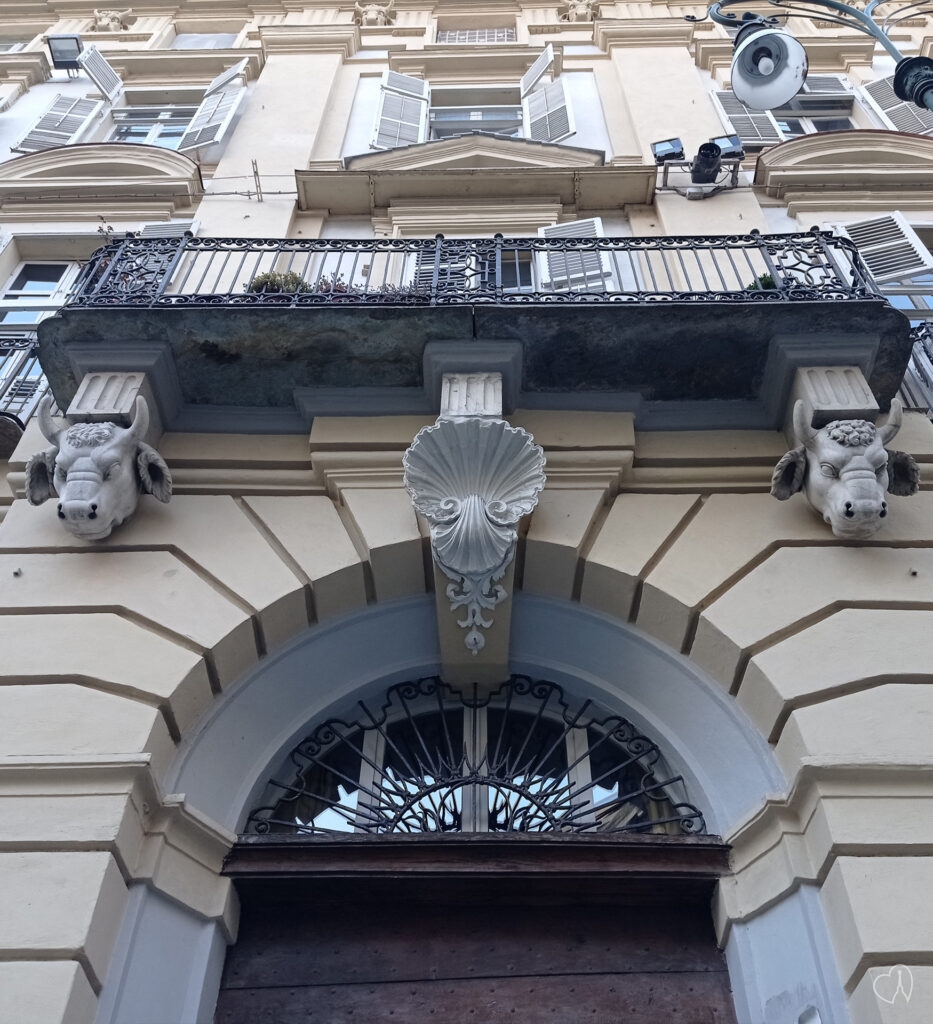
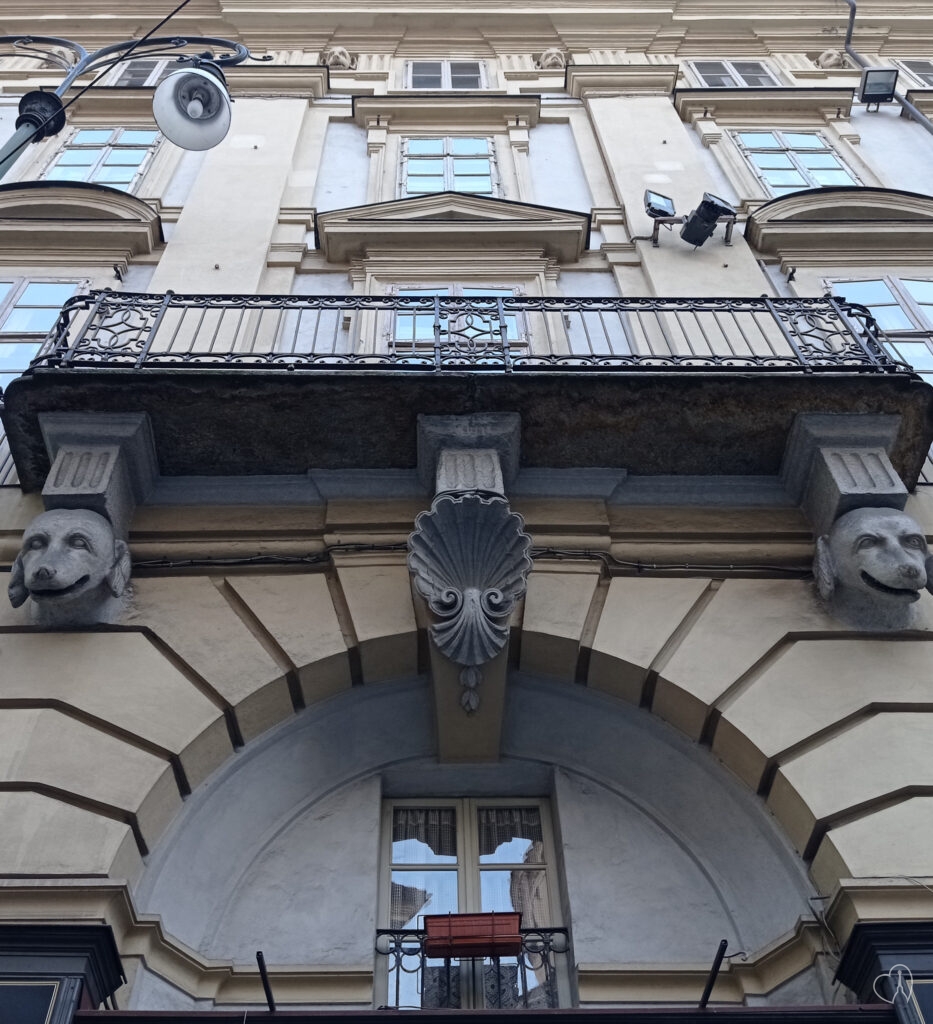
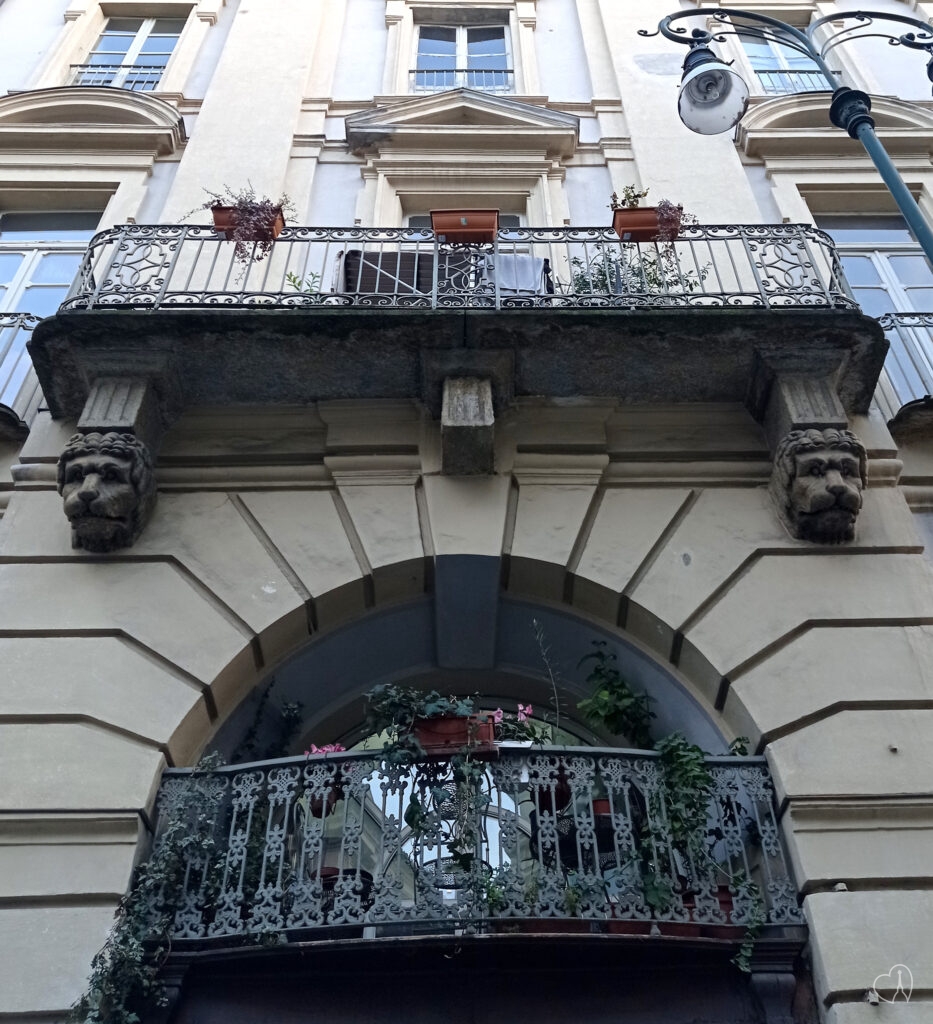
In Via Milano, in the area leading up to Piazza della Repubblica, you will find a distinctive urban widening characterised by the chamfered corners of the surrounding buildings. Looking up, you will notice the unusual sculptural decorations adorning these facades: bull, lion and dog heads peer down from above. This architectural peculiarity is one of Turin’s lesser-known yet most fascinating curiosities for those who love discovering unusual details in the urban fabric.
The zoomorphic sculptures are not mere decorative elements — they tell singular stories linked to the ownership of the buildings and the city’s culture. The bull’s head is a tribute to the very emblem of the city of Turin, whose name derives from the animal itself. The building adorned with lion heads belonged to a noble family that had the lion in its heraldic crest. Particularly curious is the symbolism of the house with dog heads, which belonged to the Dominican order. The name of this religious order, derived from the Latin “Dominus” (Lord), was wittily transformed into “Domini canes” — “the dogs of the Lord”, guardians of the faith.
Where to find it: Via Milano, corner of Via Santa Chiara.
The bat palace in Via Madama Cristina


In Via Madama Cristina, in the San Salvario neighbourhood, stands the so-called “Bat Palace“. Two enormous stone bats, crouching beneath the third-floor balconies, keep watch over the street with an unsettling air.
These sculpted animals were added in 1876 by the building’s owner, most likely to astonish and intrigue passers-by. Yet they blend so well into the building’s facade that they often go unnoticed.
Where to find it: Via Madama Cristina 19, Turin
The bull bursting through the wall in the Quadrilatero Romano

Walking through the Quadrilatero Romano, in Via delle Orfane opposite the small Piazzetta Visitazione, you will notice a bull’s head breaking out of the wall. This is an installation by artist Richi Ferrero, entitled T’oro — a pun on “toro” (bull) and “oro” (gold) — for the gilded horns of the animal that crack through the wall, sending bricks flying into the air.
Where to find it: Via delle Orfane 20, Turin
The Toret: Turin’s iconic drinking fountains

The bull, Turin’s heraldic animal, appears at various points around the city in the form of a drinking fountain. The Toret (Piedmontese diminutive of “toro”, bull) are an integral part of Turin’s urban landscape. Introduced from 1860 onwards to guarantee citizens’ access to water, there are now over 800 Toret scattered throughout the city, from parks to squares. They have become one of the city’s most distinctive features, widely reproduced as souvenirs and gadgets.
Which are the most curious Toret?
Some Toret are genuine curiosities in their own right. For example:
- the Fontana dei Sette Toret in Via Stradella 177: seven Toret arranged in a semicircle in a garden
- the Toret with a lioness head at Parco della Pellerina: a fountain distinguished by a lioness (or perhaps bear) head in place of the traditional bull’s head
- the two Toret facing each other, in Via Stampatori 4
Architectural curiosities
The palazzo with the piercing: urban art that surprises
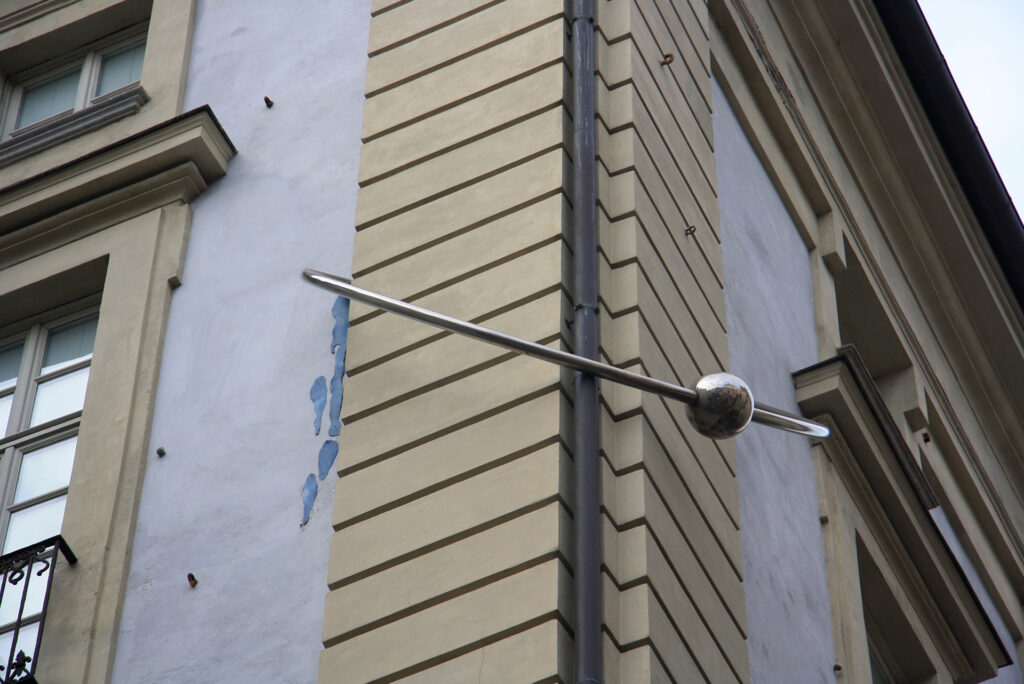
In the heart of the historic centre, a short walk from Piazza Castello, stands one of the city’s most curious and photographed sights: the so-called “Palazzo with the Piercing“. The work, conceived by architect Corrado Levi and the Cliostraat collective, consists of an enormous metal piercing that passes through the corner of the fourth floor of an eighteenth-century building in Piazzetta Corpus Domini, in the Quadrilatero Romano.
The sculpture, conceived as temporary, has become an integral part of the city. The coloured drops of blood flowing from the piercing symbolise Turin’s contrasting souls: the noble (blue) and the popular (red). The “Palazzo with the Piercing” is now one of the symbols of contemporary Turin — a city capable of engaging with its own history without fear of daring.
Where to find it: Via Palazzo di Città 19, Turin
The Fetta di Polenta: ingenuity and eccentricity by Antonelli

Among Turin’s most extravagant architectures stands the “Fetta di Polenta” (Polenta Slice), a building designed by the brilliant Alessandro Antonelli — the architect who loved a challenge and who gave the city the Mole. Its name derives from its slender shape and yellow colour, which recall a slice of polenta. But its true peculiarity lies in its width: the narrowest side measures just 54 centimetres.
This apparently impossible construction is a masterpiece of engineering and creativity. The Fetta di Polenta represents the Turinese ability to make use of every space, however improbable, transforming constraints into architectural opportunities.
Where to find it: Corso San Maurizio, corner of Via Giulia di Barolo.
Find out more: visit the dedicated page on the Fetta di Polenta.
Cannonballs in the walls: traces of ancient battles

Walking through Turin’s historic centre, you can go hunting for cannonballs embedded in the walls of buildings. These remnants of war date back to the sieges the city endured in centuries past and have been deliberately left in place as historical testimony.
The cannonballs are a tangible memory of the wars that have marked Turin’s history and represent a curious open-air museum, often ignored by distracted passers-by. The one in the photograph is in Piazza San Carlo, where a new cannonball was recently discovered during the restoration of Palazzo Barbaroux at number 217, having remained hidden beneath the plaster for centuries.
The pomegranate door: an Art Nouveau gem in Via Argentero
At Via Argentero 4, in the San Salvario neighbourhood, stands the famous “Pomegranate Door“, one of the finest examples of Art Nouveau entrance doors in Turin. Created in 1904 by Pietro Fenoglio, the architect behind Turin’s most celebrated Art Nouveau buildings, the door is decorated with branches, leaves and pomegranate fruits in wrought iron, recently repainted in vivid colours.
Beyond the beauty of the door itself, the entire building is a masterpiece of Art Nouveau architecture, with balconies supported by iron structures and coloured majolica tiles. A corner of elegance and creativity well worth a visit.
The Casa dell’Obelisco in Piazza Crimea


From Art Nouveau to neo-Liberty with this curious building in Piazza Crimea, known as the “Casa dell’Obelisco” and designed by architects Sergio Jaretti Sodano and Elio Luzi between 1954 and 1959. This residential building stands out for its curvilinear facades and innovative use of lithoconcrete, which creates plays of light and shadow, lending the structure a sense of dynamism.
The Casa dell’Obelisco represents an aesthetic provocation in relation to Turin’s architecture, which is typically dominated by squared, sober lines.
The building takes its name from the obelisk located in the adjacent square, erected in 1892 in honour of the Kingdom of Sardinia’s participation in the Crimean War. In 1971, the Casa dell’Obelisco was chosen as a location for Dario Argento’s film “The Cat o’ Nine Tails”.
Where to find it: Piazza Crimea 2, Turin
25 Verde: Turin’s vertical forest

Among the city’s most singular and curious contemporary architectures is “25 Verde“, Turin’s first forest-condominium, designed by architect Luciano Pia. The building, situated in Via Chiabrera, is home to over 150 trees growing on its balconies and terraces, creating a natural microclimate and a visually unique impact.
25 Verde is an example of bioarchitecture that combines sustainability, design and urban quality of life. A symbol of a Turin that looks to the future without forgetting the beauty of nature.
Where to find it: Via Gabriele Chiabrera 25, Turin
The submarine in Parco del Valentino

Among the most unusual things in Turin is a surprising naval relic that emerges from the greenery of the Parco del Valentino: the central section of the submarine Andrea Provana. Located along Viale Marinai d’Italia, beside the Turin headquarters of the National Association of Italian Sailors, this piece of history overlooking the Po is one of the most important naval artefacts in Italy preserved outside a museum.
Built in 1915 and launched in 1918, the Andrea Provana was used for training purposes and, although it took no part in combat operations, was involved in strategic manoeuvres during the Corfu Crisis of 1923. Following an accidental explosion in 1927 and subsequent decommissioning, the central section of the submarine was exhibited at the 1928 International Exhibition. In 1933, it found its permanent home in the heart of the Valentino, becoming a curious city monument.
Where to find it: Viale Marinai d’Italia 1, Turin
Turinese superstitions and lucky charms
Christopher Columbus’s finger: the superstitious ritual of Piazza Castello
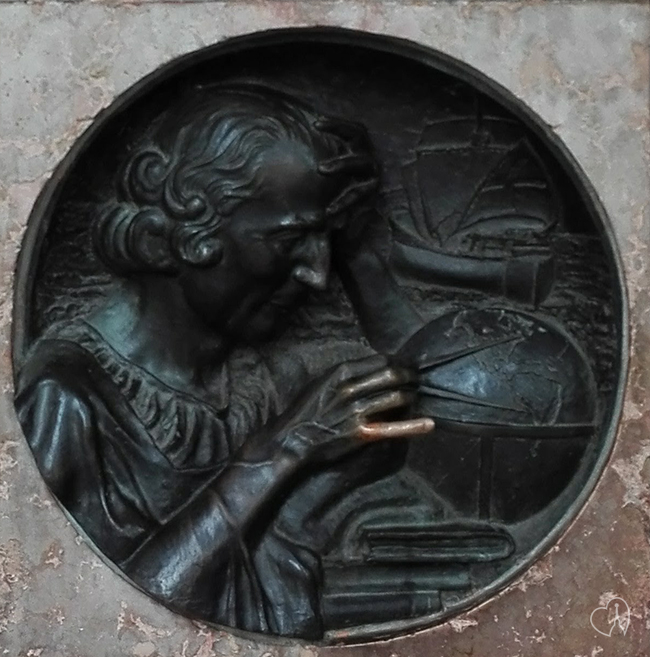
Beneath the arcades of the Prefettura in Piazza Castello there is a bronze medallion depicting Christopher Columbus. According to popular tradition, touching the little finger of the navigator’s hand brings good luck, especially for students hoping for good exam results.
Columbus’s finger, now worn smooth by the hands of thousands of people, has become one of the city’s most beloved and photographed lucky charms. A small superstitious gesture that reveals the more playful and human side of Turin.
Where to find it: Piazza Castello 195, Turin
The bull of Piazza San Carlo: treading on good fortune

The rampant bronze bull set into the pavement beneath the arcades in front of Caffè Torino in Piazza San Carlo is the most famous of Turin’s superstitious traditions: legend has it that treading on the bull’s genitals brings good luck. This custom, practised with quiet discretion by Turinese locals, has become a genuine ritual for anyone passing through the square.
The purple ceiling of the Teatro Regio
On the subject of superstitions, it is well known that in the theatre world the colour purple is traditionally avoided, being associated with Lent — a period during which theatrical performances were forbidden in the Middle Ages, bringing interruptions to activities and lost earnings for actors. In Turin, however, the Teatro Regio defies this superstition: Carlo Mollino’s design features a ceiling and interiors in shades of purple. Mollino deliberately chose this colour to heighten the scenic effect and break with convention, creating an immersive, enveloping environment that intensifies the theatrical experience.

The mural dedicated to Piero Angela
Piero Angela was born in Turin, and right beside the RAI building you can see a gigantic mural dedicated to him. To find out more about its story and exact location, visit the dedicated page.


Do you know of any other curiosities and oddities in Turin? Let us know in the comments!